Every state has felt the job losses, which came via terminations or by Internal Revenue Service workers who left under deferred resignation terms.

Photo by Ron Lach
When 2025 began, around 103,000 people worked at the Internal Revenue Service nationwide.
Then the Trump administration and Elon Musk’s Department of Government Efficiency (DOGE) arrived.
Now, according to a new report by the Treasury Inspector General for Tax Administration (TIGTA), the IRS ranks have been reduced by more than 11,400 workers.
That’s an 11 percent cut in the tax agency’s workforce.
The job losses, which TIGTA collectively refers to as separations, come from both terminations and IRS employees who accepted DOGE’s deferred resignation program (DPR) offer. Under DPR, IRS workers (and other federal employees) were allowed to resign with pay and benefits remaining in place through Sept. 30.
Most of the terminations were of 7,315 probationary employees. These generally are employees with less than one year of service, and in the excepted service with less than two years of service. They can be terminated without triggering Merit Systems Protection Board appeal rights.
Another 4,128 IRS employees were allowed to take the DRP route, with 522 more employees awaiting word on their DRP applications as of March 2025, the date TIGTA concluded its report.
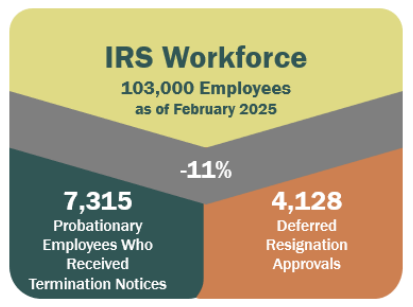
Total separations from IRS workforce.
Source: TIGTA analysis of IRS Human Capital Office data as of March 2025 and
Treasury Integrated Management Information System (TIMIS) data as of February 2025.
These 11,443 former IRS workers represent this weekend’s By the Numbers figure.
Some IRS units hit harder: TIGTA notes, not surprisingly, that the overall IRS staff departures impact certain of the agency’s business units more than others.
Additionally, the separations disproportionately impacted employees in certain positions. TIGTA points out, for example, that approximately 31 percent of revenue agents left or were terminated, while 5 percent of Information Technology management separated.
The top six IRS business units affected by the layoffs and by how much are —
|
IRS Unit |
Responsibility |
Number |
Percentage Impact |
|
Tax Exempt and Government Entities (TE/GE) |
Helps these tax-paying entities comply with tax laws, including pension plan requirements |
694 |
31% |
|
Large Business and International (LB&I) |
Assists corporations and partnerships with assets greater than $10 million comply with tax laws, as well as those facing emerging international issues |
1,733 |
25% |
|
Small Business and Self Employed (SB/SE) |
Helps smaller firms understand and meet their tax obligations |
5,765 |
23% |
|
Human Capital Office (HCO) |
Supports IRS employees and Human Resource issues |
207 |
7% |
|
Information Technology (IT) |
Assists IRS employees with technological services and solutions |
450 |
5% |
|
Taxpayer Services (TS) |
Helping individual filers understand and comply with tax laws |
1,714 |
4% |
Types of jobs lost: Additionally, the separations disproportionately impacted employees in certain positions.
For example, the number of revenue agents, the IRS personnel who conduct audits, declined by approximately 31 percent. According to the IRS, in Fiscal Year 2023, examination activities recommended approximately $32 billion in additional tax assessments.
The top six job types affected by the separations are the revenue agents; revenue officers who collect delinquent taxes; tax examiners who process returns; contact representatives who help taxpayers resolve issues; IT management; and various clerical workers and assistants.
The breakout of these job cuts are —
|
IRS Unit |
Number |
Percentage Impact |
|
Revenue agents |
3,623 |
31% |
|
Revenue officers |
611 |
18% |
|
Contact representatives |
2,599 |
10% |
|
Tax examiners |
1,613 |
10% |
|
Clerical/assistants |
306 |
5% |
|
IT management |
424 |
5% |
Nationwide IRS job losses: When people here Internal Revenue Service, they think of the agency’s headquarters in Washington, D.C. But Uncle Sam’s tax collectors and more live and work all across the United States.
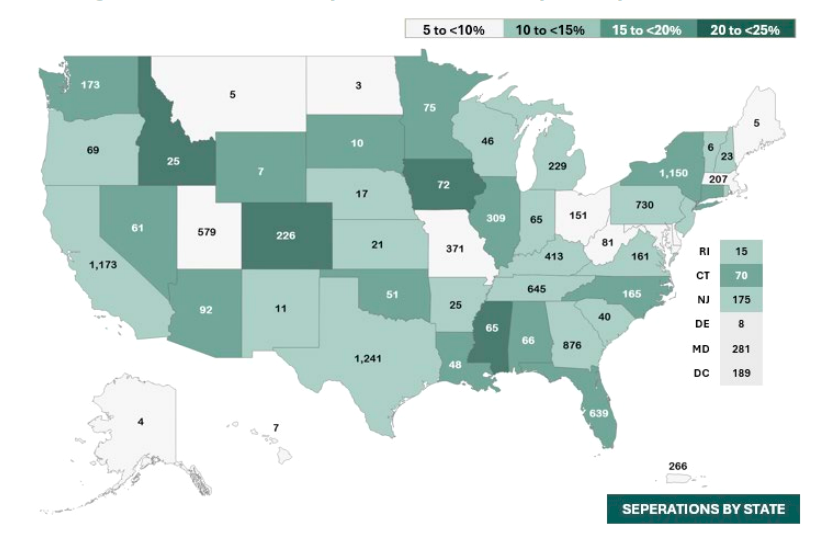
So, reductions in the IRS workforce has had nationwide implications. Every state, the District of Columbia, and Puerto Rico had probationary employees who received termination notices or accepted the DRP.
While my home state of Texas has the most job losses (so far) in raw numbers — 1,241 now former IRS workers — Iowa, Colorado, Mississippi, and Idaho had the highest percentage of employee separations compared to the agency’s workforce in those states.
The map below from the TIGTA report shows the states where the affected employees worked and their associated job losses and percentages of employees separating compared to the IRS workforce in the states.
Tax collection recommendations: TIGTA noted that it conducted the IRS personnel analysis simply as an update on the IRS efforts to reduce its workforce per Donald J. Trump’s overall goal of reducing the federal workforce. The independent IRS watchdog made no recommendations.
I, however, have some suggestions.
The GOP is the small government party. But even smaller government entities need money.
Congress needs to look long and hard the long-term effects of drastically cutting the agency that is responsible for collecting the funds that all of Uncle Sam’s operations need to operate effectively.
That’s especially true when it comes to collecting from those trying to cheat.
The loss of auditors, particularly those who are trained to investigate the complex tax avoidance and evasion techniques that are used by large companies and wealthy taxpayers, will mean a notable drop for the U.S. Treasury.
Remember that IRS statistic cited earlier? Tax examination activities in fiscal year 2023 recommended approximately $32 billion in additional tax assessments.
Plus, allowing higher-income taxpayers to more easily skirt their tax responsibilities seriously undercuts the IRS’ commitment to fairly enforcing tax laws. Worse, it encourages more taxpayers, both individuals and businesses, at all income levels to try to do the same.
You also might find these items of interest:
- Proposed IRS layoffs could cost U.S. $2.4 trillion
- Rapid-fire IRS leadership changes during tax filing week
- ‘Critical’ IRS employees told they can’t take resignation offer
- TIGTA investigating DOGE and White House incursion into IRS
Advertisements
🌟 Search Amazon Tax Products 🌟
The text link above is an affiliate ad. If you click through and then buy a product, I receive a commission.