No, we still haven’t seen Donald Trump’s federal tax returns.

Donald Trump shared this photo on his Twitter account last October of him signing what he said was his 2015 federal tax return. However, it was old state returns that have given us a glimpse into the Republican presidential candidate’s tax bills.
…
The information about his $916 million business loss in 1995 comes from state tax returns filed with New York, New Jersey and Connecticut for that year and which were obtained by the New York Times.
While that yuge loss could have, as the Times notes, served as a massive, and legal, deduction that may have allowed the Republican presidential candidate to legally avoid paying federal income taxes for 18 years, that possibility is still just supposition.
Unless or until Trump releases the 1040s he’s filed with the Internal Revenue Service for any year, we are still just operating on tax guesswork. They are some solid guesses by many tax pros, but guesses nonetheless.
State tax data was key: The fact that the new questions about The Donald’s federal taxes were extrapolated from some state filings is interesting for many reasons.
One is the cover it provides the newspaper in disseminating The Donald’s likely tax data, According to some legal arguments, the most detailed being the explanation offered by Slate, the publication of Trump’s tax revelations are not illegal.
The release of state tax information by someone other than the taxpayer apparently is not illegal under federal law. That law only deals with federal returns.
And the three states that got the Trump return, apparently filed two decades ago jointly with his then second wife Marla Maples, do not have any statutes governing unauthorized publication of tax returns.
How state/federal taxes are connected: The other reason that the New York Times‘ use of state tax info is so intriguing is that it shows just how intertwined state and federal taxes are.
State tax systems are, of course, devised by each state’s lawmakers, meaning each jurisdiction’s taxes vary.
Seven states — Alaska, Florida, Nevada, South Dakota, Texas, Washington and Wyoming — don’t have any personal income tax. Two others, New Hampshire and Tennessee, collect only from folks who having dividend and interest earnings.
But in the 41 states and Washington, D.C., that do tax their residents’ incomes, those tax laws are for the most connected with our federal filings.
Most state tax systems tend to rely on the progressive tax structure of the federal income tax. They also, to a large degree, conform to many features of the federal tax code, using similar definitions of what is considered income, what can be deducted and how certain tax transactions are treated.
Federal Form 1040 as starting point: Even when it comes to the basic act of filing a state tax return, in most cases that can’t be done until the taxpayer completes at least part of his or her federal return.
Federation of Tax Administrators’ data show that 37 of the 42 jurisdictions that have a broad-based individual income tax use their filers’ federal taxes as a starting point.
State Personal Income Taxes
Federal Starting Points as of Jan. 1, 2016
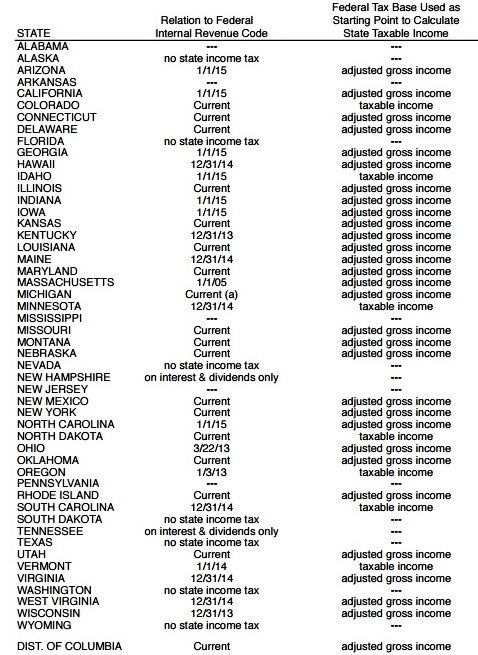
Source: Compiled by the Federation of Tax Administrators from various sources.
— Indicates state does not employ a federal starting point.
Current indicates state has adopted Internal Revenue Code (IRC) as currently in effect.
Dates indicate state has adopted IRC as amended to that date.
(a) Indicates Michigan’s taxpayers can choose to use either current or 1/1/96 federal law.
The first entry a filer makes on 30 states’ tax returns is either the taxpayer’s federal adjusted gross income. In seven states, tax officials in those jurisdictions as for the state taxpayer’s federal taxable income amount.
Figuring state taxes from there: Once that federal income amount is determined, notes the Federation of Tax Administrators in a 2005 submission to the President’s Advisory Panel on Federal Tax Reform, the state tax calculations then proceed as:
Federal Tax Base
Plus or Minus: State modifications
Minus: State personal exemptions
Minus: State standard deduction or itemized deductions (based on federal)
Equals: State taxable income
Multiplied by: State Tax Rates
Equals: Tentative State Tax Liability
Minus: State Tax Credits
Equals: Final State Liability
The federal tax base plus or minus state modifications then less state personal exemptions and less state standard deduction or state itemized deductions (based on federal itemized deductions) yields the state’s taxable income, explains FTA.
That amount of income then is used to figure the state taxpayer’s liability based on the state’s income tax rate or brackets.
So remember when you fill out your federal Form 1040 for Uncle Sam, you’re probably setting the foundation for your state taxes.
And remember, too, that any of your state or federal returns could come under scrutiny if one day you run for president.
You also might find these items of interest: