
Life today demands multitasking. That includes taxes.
And the champion here is the health savings account, or HSA. It offers three tax advantages.
First, contributions to an HSA are made before taxes are assessed on the money. This lowers your taxable income a bit.
Second, HSA funds grow tax-free.
Third, when you use HSA money to pay eligible medical expenses, those withdrawals are tax-free, too.
A flexible, multiple, and mobile savings option: But wait. There’s more.
There’s no use-or-lose with an HSA. The full amount in the account simply rolls over from year to year.
Plus, an HSA is quite flexible.
Unlike the similar-sounding FSA, or flexible spending account, another tax-advantaged account to help pay medical costs, your HSA is not tied to your employer. You own your HSA and can take it with you if you change jobs.
As long as you have an HDHP, you can continue to contribute to the HSA and use the funds to help cover medical costs until you meet the deductible.
And eventually, HSA flexibility can extend to your post-work years.
Once you turn 65, you can use the money for non-medical expenses with no tax penalty at all. The only tax consideration here is the payment of tax, at ordinary rates, on the withdrawals that don’t go toward health care.
This dual savings purpose is why so many younger workers are turning to HSAs as their preferred medical expenses and retirement savings option.
A Schwab survey released this fall found that around half of Gen Z and Millennial workers, 50 percent and 48 percent, respectively, use their HSAs to save for healthcare costs and their future retirement.
HDHP is key HSA requirement: OK, you’re sold. You want a medical/retirement HSA.
But there’s one thing you must do before you can open an HSA. You’ve got to be enrolled in in high deductible health plan (HDHP).
An HDHP is just what its name says. The coverage doesn’t kick in until you meet the higher deductible amount, which generally is much larger than other workplace provided plans. But in exchange, you pay a relatively smaller monthly premium.
That reduced upfront premium saving is also why HDHPs also are appealing to many younger workers. They tend to be healthy, but aren’t yet making much money.
The medical deductible amount for an HDHP is adjusted annually, if inflation warrants. For 2022, the IRS deems a plan high-deductible when medical expenses to trigger coverage hit $1,400 or more for individual coverage, or $2,800 or more for a family plan.
Once you enroll in the HDHP, then you can establish the companion HSA. The contribution amounts to the account also is inflation adjusted.
This year, if you have individual coverage, you can put up to $3,650 in your HSA. The HSA contribution limit is $7,300 for family coverage. If you’re 55 or older, you can contribute an extra $1,000 for the tax year.
Getting the HSA contribution tax break: Again, HSA contributions are tax-free. If you have a workplace-provided HDHP and contribute automatically via direct payroll amounts sent to your HSA, the money won’t be counted in your income on your annual W-2.
If, however, you buy your HDHP coverage on your own, or choose a bank or brokerage other than the one your employer uses for HSAs, then you put the funds into the account yourself.
In this self-contributing case, you’ll claim the HSA tax break on Form 8889, an excerpt of which is shown below, when you file your annual return.
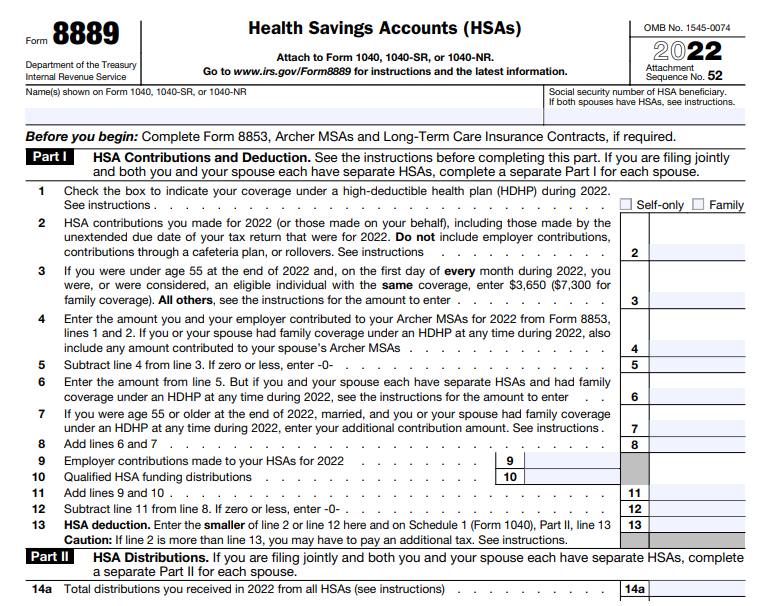
Although you do have to fill out this form, you don’t have to itemize to claim your HSA tax deduction. You transfer the relevant information from Form 8889 to Line 13 of Form 1040 Schedule 1.
Contribute now: If you do have an HSA, you definitely want to make sure you’ve put in enough to cover any end-of-year medical expenses.
But you also might want to boost the amount even if you’re feeling fine. Putting in extra cash can boost the eventual retirement help you HSA can provide.
Yes, you do have until next April’s Tax Day to max out your HSA contribution amount. But why wait? If you have the cash now, your tax-free additions will have a bit longer to grow.
You also might find these items of interest:
- IRS announces 2023 inflation hikes for HDHPs, tax-favored HSAs
- Tax Turkey to Avoid #5: Losing FSA money you left in your health care account
- No more unexpected medical bills, permanent 7.5% itemized healthcare costs threshold