
Before gig work because the popular way to make extra money, a lot of folks relied on their hobbies.
One of my neighbors, for example, loves to spend his weekends snapping photos of the many natural areas here in Central Texas. But he soon discovered that he can pocket some extra cash by aiming his camera at weddings, anniversary celebrations, and youngsters’ birthday parties.
He doesn’t consider it a second job, but maybe he should.
The extra cash he’s making from his avocation is taxable income. If he operates it as a business, he might be able to deduct some of his photography expenses.
That shift, however, will requires some different, and added, tax responsibilities.
Here are some tips on deciding between a hobby or business, and how to meet the tax obligations of the added income either way.
Hobby dollars: My shutterbug neighbor must report his hobby earnings on his regular individual tax return.
The amount is considered additional income that is first reported on Form 1040’s Schedule 1, Additional Income and Adjustments to Income. Specifically, it goes on line 8j, Activity not engaged in for profit. That’s it highlighted in the Schedule 1 excerpt below.
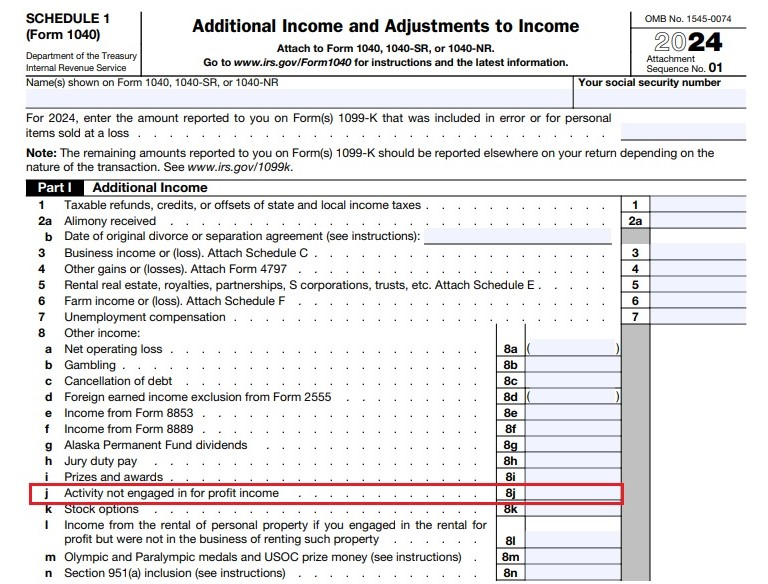
See more tax forms and more about them at Tax Forms 2025.
~
That and all other entries on Schedule 1, Part 1, Additional Income, are totaled and then transferred to Form 1040 (or 1040-SR for older taxpayers or 1040-NR used by nonresident aliens). Specifically, the additional earnings go from Schedule 1, line 10, to the appropriate 1040 form’s line 8.
It’s pretty straightforward, and the tax route that most people who make a little money from their hobbies should follow.
But what if my neighbor’s personal paying photo gigs increase? It might be worthwhile for him to consider making it, in the eyes of the IRS, a business.
When to become a business: The biggest, and most obvious, difference between a hobby and a business is that businesses operate to make a profit, while hobbies are for pleasure or recreation.
So, when your hobby starts generating a lot of income, turning it into a business might be a good tax move. Your expenses associated with a business activity, for example, could be tax deductible, lowering the amount of earnings that’s taxable.
But making a hobby isn’t as simple as just printing business cards. The Internal Revenue Code has some specific rules and regulations for what is considered a business.
There are, however, your answers to some general questions could help you make the hobby-to-business decision. They include —
- Do you intend to make a profit?
- If the activity makes a profit, how much is it?
- Can you expect to make a future profit from the appreciation of the assets used in the activity?
- Do you depend on income from the activity for your livelihood?
- Are any losses due to circumstances beyond your control or are the losses normal for the startup phase of your type of business?
- Do you adjust operations to improve profitability?
- Do you carry out the activity like a business, keeping complete and accurate books and records?
- Do you and your advisors have the knowledge needed to carry out the activity as a successful business?
No single question and answer is the deciding factor. The IRS considers the proverbial facts and circumstances when determining whether your activity is a legitimate business.
You, too, should review all the factors to make the best decision on whether to continue your hobby activity, or turn it into a business.
Key business and tax factors: Personally, I want to emphasize a couple of the factors listed above.
First, there’s the record keeping component.
If you’re going to run a business, then you need to separate it from your personal taxes. When you buy business supplies, use a business or dedicated credit card. Open a separate bank account if you can find an institution that will provide it with no or low fees.
And, as with all things tax, keep good, complete records of all your business earnings and expenses. Remember, whenever the IRS has questions, the burden of proving what you enter on your return is always on you, the taxpayer, regardless of whether you’re an individual or business filer.
Second, commit to making money. I know that sounds obvious, but you can’t just hope your hobby-turned-business will turn a profit. You need to go into the activity with a specific profit motive intent, and then commit to doing just that.
If the IRS has the slightest inkling that you’re simply using your so-called business to lower earnings, and perhaps even create losses, you’ll be in tax trouble. The least of which is the disallowance of the business expenses you claimed.
Business filing differences: Once you’ve starting earning business dollars, your tax filing will be different. Rather than simply reporting the income on your 1040, you’ll have to deal with other forms and, in some cases, deadlines.
The business structure you choose will determine how you pay your new entity’s taxes. Among the most common choices for small businesses are —
- Sole proprietorship: Individuals who own unincorporated businesses exclusively, by and for themselves are sole proprietors.
- Partnerships: A partnership is the relationship between two or more people to conduct trade or business, with each person contributing money, property, labor, or skill and sharing in the profits and losses of the business.
- Corporations: In a corporation, prospective shareholders exchange money, property, or both in order to acquire the corporation’s capital stock.
- S corporations: An S corporation is a corporation that elects to pass corporate income, losses, deductions, and credits to its shareholders for federal tax purposes.
- Limited liability company (LLC): An LLC may be treated as a corporation, a partnership, or as part of the owner’s tax return (e.g., sole proprietorship), depending on elections made by the LLC and its members. LLCs may also be subject to state regulations, which vary from state to state.
Most very small businesses start as sole proprietorships. Here, you report your business earnings and claim allowable deductions on Schedule C, Profit or Loss from Business (Sole Proprietorship), and submit it with your annual Form 1040 on April’s Tax Day.
Deciding which business entity isn’t a task to take lightly. So before you expand your crafting skill to an online store or open a farmers’ market stand to sell the homemade bread your friends and family rave about, talk with a tax professional.
That adviser also can help ensure you meet all the local and state tax and business regulations for your new business.
And, most importantly, reputable counsel will ensure that your new entrepreneurial endeavor will have a better chance of succeeding.
You also might find these items of interest:
- Being the boss tax basics
- 11 steps (tax and more) to starting a business
- Added summer income means more tax considerations
- IRS touts enhanced tax options for businesses with online accounts
Advertisements
🌟 Search Amazon Home Audio Products 🌟
The text link above is an affiliate ad. If you click through and then buy a product, I receive a commission.