


Photo by Joshua Rodriguez on Unsplash
…
It’s National Small Business Week 2024!
Technically, the U.S. Small Business Administration’s annual recognition event started yesterday, Sunday, April 28.
The kick-off yesterday of this year’s National Small Business Week (NSBW) included an awards ceremony where this year’s National Small Business Person of the Year and runner-up were named, along with the Small Business Persons of the Year from each state, the District of Columbia, Guam, and Puerto Rico.
The event, with a theme this year of Building on America’s Small Business Boom, continues through Saturday, May 4.
Your small business taxes: The full seven-day schedule focuses on start-up resources and information available from the SBA and its supporters. One of NSBW’s perennial partners is the Internal Revenue Service, since taxes play a big part in all companies’ operation.
Federal law requires all individuals, including small business owners, to pay taxes on all income earned. This typically involves making quarterly estimated tax payments.
Then there are the business’ tax responsibilities. How business taxes are paid depends on the business structure you selected for your entity. Among the most common choices for small businesses are —
- Sole proprietorship. Individuals who own unincorporated businesses exclusively, by and for themselves are sole proprietors.
- Partnerships. A partnership is the relationship between two or more people to conduct trade or business, with each person contributing money, property, labor, or skill and sharing in the profits and losses of the business.
- Corporations. In a corporation, prospective shareholders exchange money, property, or both in order to acquire the corporation’s capital stock.
- S corporations. An S corporation is a corporation that elects to pass corporate income, losses, deductions, and credits to its shareholders for federal tax purposes.
- Limited liability company (LLC). An LLC may be treated as a corporation, a partnership, or as part of the owner’s tax return (e.g., sole proprietorship), depending on elections made by the LLC and its members. LLCs may also be subject to state regulations, which vary from state to state.
The entity types listed above also are links to the special IRS pages with more information on each business type’s tax responsibilities. My post Tax implications of business entity choices includes a table showing which taxes apply to which business types.
Basic business taxes: As for those taxes, there are four generally recognized business tax types:
- Income tax. All businesses except partnerships must file an annual income tax return. Partnerships mut file an information return. The form you use, and the deadline for filing, depends on your business structure.
- Self-employment tax. Self-employed business people generally must pay SE tax by filing Schedule SE when net earnings from self-employment are $400 or more. This is self-employed version of paying the Federal Insurance Contributions Act (FICA) required Social Security and Medicare taxes. There are special rules and exceptions for a church or a qualified church-controlled organization, aliens, fishing crew members, notary public, state or local government employees, foreign government, or international organization employees.
- Employment tax. If you have employees, you as the employer have certain employment tax responsibilities, including taxes you must pay and forms you must file, aka payroll taxes. Employment taxes include workers’ FICA taxes, federal and state income tax withholding, and federal unemployment (FUTA) tax.
- Excise tax. You might have to pay and file certain form for various excise taxes if you manufacture or sell certain products; operate certain kinds of businesses; use various kinds of equipment, facilities, or products; or receive payment for certain services.
You can find more on these at IRS.gov’s general business tax overview page.
And don’t forget about your state’s business laws and regulations. An IRS curated page has links to the state offices with details on doing business in each jurisdiction.
Other NSBW resources: As inconceivable at it might seem, some business owners would like or need more than tax information. The SBA and NSBW 2024 has you covered.
SBA National small businesses week 2024 includes a virtual summit April 30 through May 1. The two-day online event is free, and includes business workshops, networking opportunities, information on federal resources, and insights from expert speakers geared toward entrepreneurs looking to start and grow businesses.
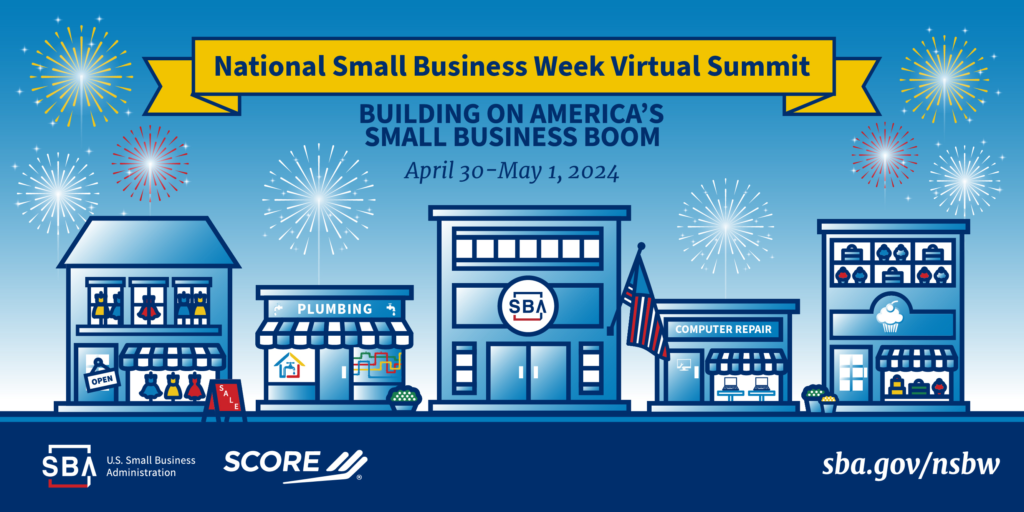
Sessions will cover such topics as using artificial intelligence (AI) to boost and grow your business; online marketing tips; cash flow strategies; turning a side hustle into a full-time business; and the very popular (and critical) issue of obtaining business funding.
Those are just a few of the virtual summit’s offerings. You can get more information and register here.
I know it’s hard for a small business owner to find time to do anything other than take care of business. Committed entrepreneurs don’t just put in Monday-through-Friday, 40-hour work weeks. They are continually on the job.
But it could be worth your and your company’s while to check out some of the 2024 National Small Business Week resources and summit sessions.
You also might find these items of interest:
- 7 warning signs you filed an incorrect ERC claim
- The importance of good, and separate, business records
- Maryland woman pleads guilty to collecting but not remitting $2.7 million in employment taxes
Advertisements
🌟 Search Amazon Business and Money Books 🌟
The text link above is an affiliate ad. If you click through and then buy a product, I receive a commission.
